Table of Contents
You open a job ad. “Looking for a full-stack developer.” Then the list begins: React, Node, Python, AWS, Docker, Kubernetes, PostgreSQL, MongoDB, GraphQL, CI/CD, and “strong design sense.” You read it twice and think: is one human supposed to be all of this?
No. And that is the myth. The job ad below is the kind of thing that makes good developers feel like frauds.
✅ Strong Node.js, Python and PHP
✅ PostgreSQL, MySQL, MongoDB, Redis
✅ AWS, Docker, Kubernetes, CI/CD pipelines
✅ UI/UX design skills, Figma
✅ Mobile apps (React Native a plus)
✅ SEO, analytics and “a growth mindset”
A job ad of the kind you see every week (illustration). Nobody is an expert in all of this.
What this article gives you (9 minute read):
✓ What the stack really is, drawn as a diagram
✓ Four myths about full-stack developers, and the honest reality
✓ One real feature built end to end: form → API → database, with full code you can copy
✓ An interactive “follow the request” demo so the whole flow finally clicks
✓ A realistic learning path, and how to know when you are ready to say “full-stack”
First, What Is “The Stack”?
A web application is built in layers. Your browser sits at the top, a database at the bottom, and a server in the middle passing messages between them. “The stack” is simply the name for all of those layers together.
The stack, top to bottom. A “full-stack developer” can work at every level. That does not mean mastering every box.
The sentence that fixes the confusion: full-stack means you can move through the whole stack. It does not mean you are an expert at every layer. Nobody is.
Four Myths, and the Honest Reality
The job ad lists React, Angular, Vue, Node, Python, PHP and four databases. The word “and” is doing a lot of damage there.
REALITYReal full-stack developers know one path through the stack very well. For example: React + Node + PostgreSQL. Or WordPress + PHP + MySQL. When they need another tool, they learn it for that project, because the underlying ideas transfer.
People imagine a perfectly balanced developer who designs beautiful interfaces in the morning and tunes database indexes in the afternoon.
REALITYAlmost every full-stack developer leans one way. They are “front-end leaning” or “back-end leaning”, and they are honest about it. That is not a weakness. It is what makes them hireable.
This is the myth that managers believe, and the one that burns people out.
REALITYOne person can build and ship a complete small product. That is genuinely powerful. But a serious product also needs design, testing, security, infrastructure and support. Speed at small scale is not the same as depth at large scale.
Beginners jump between React, Node, Docker and AWS in the same month and end up knowing a little about everything and nothing well enough to be paid for it.
REALITYGo deep in one layer first until you can build something real on your own. Then grow sideways. Depth first, width second, in that order.
What Good Full-Stack Developers Actually Look Like
Picture the letter T. The horizontal bar is the wide, workable knowledge of the whole stack. The vertical line is the one area you go deep in. That shape is what teams actually hire.
Here is what that looks like in practice for three honest profiles. Nobody is at 100% everywhere.
Three real shapes. Notice that every one of them has a gap, and every one of them is employable.
SEE IT WORKOne Feature, Built Through the Whole Stack
Talking about layers is abstract. So let’s build the smallest real feature that touches all of them: a contact form that saves a message. Four files, about 60 lines, and every layer of the stack appears once.
Layer 1 — The form the user sees (front-end)
<!-- The part the user actually touches -->
<form id="contactForm">
  <input name="name" placeholder="Your name" required>
  <input name="email" type="email" placeholder="Your email" required>
  <textarea name="message" placeholder="Your message" required></textarea>
  <button>Send</button>
</form>
<p id="status"></p>
Layer 2 — Sending it to the server (still front-end)
const form = document.getElementById('contactForm');
const status = document.getElementById('status');

form.addEventListener('submit', async (e) => {
  e.preventDefault();              // stop the page reloading
  status.textContent = 'Sending...';

  const data = Object.fromEntries(new FormData(form));

  const res = await fetch('/api/messages', {
    method: 'POST',
    headers: { 'Content-Type': 'application/json' },
    body: JSON.stringify(data)
  });

  if (res.ok) {
    status.textContent = 'Thanks! We got your message.';
    form.reset();
  } else {
    status.textContent = 'Something went wrong. Please try again.';
  }
});
This line is the border crossing: fetch('/api/messages'). Everything above it runs in the user’s browser. Everything below it runs on your server. Understanding this one line is most of what “full-stack” means.
Layer 3 — The server receiving it (back-end)
const express = require('express');
const db = require('./db');
const app = express();
app.use(express.json());

app.post('/api/messages', async (req, res) => {
  const { name, email, message } = req.body;

  // 1. Never trust the browser. Check it again here.
  if (!name || !email || !message) {
    return res.status(400).json({ error: 'All fields are required' });
  }

  // 2. Save it. The ? placeholders block SQL injection.
  await db.query(
    'INSERT INTO messages (name, email, message) VALUES (?, ?, ?)',
    [name, email, message]
  );

  return res.status(201).json({ ok: true });
});

app.listen(3000, () => console.log('Server running on port 3000'));
The required attribute on the form is not security. Anyone can send a request straight to your API without ever opening your page. That is why the server checks the fields a second time. A front-end-only developer often misses this. Knowing why both checks exist is exactly the full-stack instinct.
Layer 4 — The table that stores it (database)
CREATE TABLE messages (
  id        INT AUTO_INCREMENT PRIMARY KEY,
  name      VARCHAR(100) NOT NULL,
  email     VARCHAR(150) NOT NULL,
  message   TEXT NOT NULL,
  created_at TIMESTAMP DEFAULT CURRENT_TIMESTAMP
);
Run the server, submit the form, and here is what you see in each place:
Press F12 in your browser and open the Network tab to watch this happen on any site you build (illustration).
mysql> SELECT id, name, email, created_at FROM messages;
+----+------+-------------------+---------------------+
| id | name | email             | created_at          |
+----+------+-------------------+---------------------+
|  1 | Azeem| azeem@example.com  | 2026-10-17 15:04:22 |
+----+------+-------------------+---------------------+
1 row in set (0.00 sec)
Example output. The message that started as text in a browser is now a row in a database. That journey is the whole job.
TRY IT YOURSELFFollow One Request Through the Stack
Click Send the form and step through what happens. At each stop you see which layer is working, who normally owns that layer, and the exact line of code responsible.
Six stops: browser → network → server → database → back again.
# Click "Send the form" to startSpecialist or Full-Stack? Both Are Right
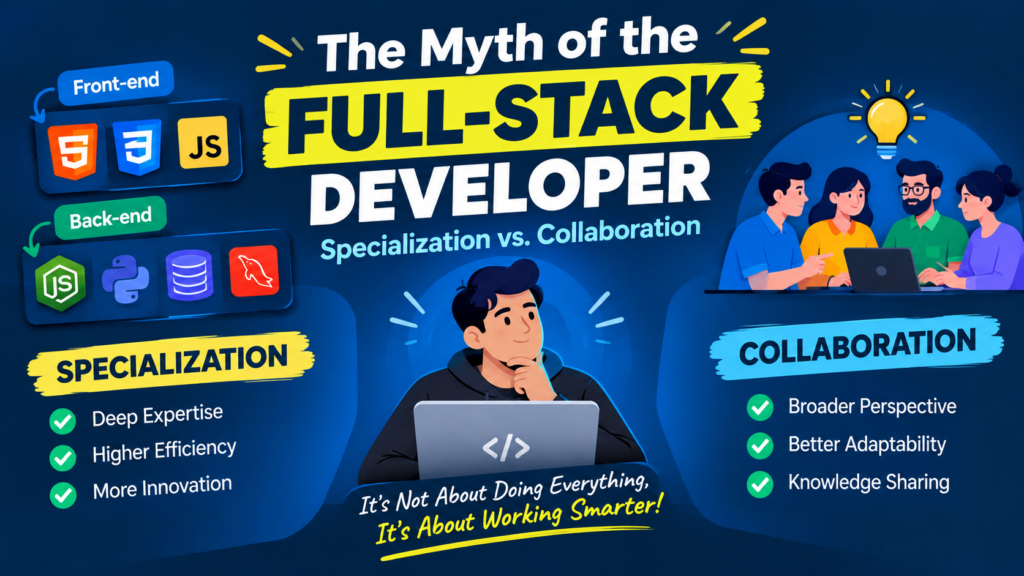
The original argument is specialization versus collaboration, and the honest answer is that it depends on where you work. Here is the trade-off without the hype.
| Specialist | Full-stack | |
|---|---|---|
| Greatest strength | Depth. Solves the hard problems others cannot. | Reach. Ships a whole feature alone. |
| Biggest risk | Blocked when work sits outside the specialty. | Spread thin, expert in nothing. |
| Fits best at | Large companies, complex products, scale problems. | Startups, agencies, freelancing, small teams. |
| Debugging style | Goes deep in one layer. | Follows the problem across layers. |
| Career path | Senior engineer, architect, domain expert. | Product engineer, tech lead, founder, freelancer. |
If you freelance or build client websites, full-stack is the right shape. A client wants a working website, not three contractors. Being able to take a project from design to deployment on your own is a genuine business advantage.
A Realistic Learning Path
Forget the 30-day roadmaps. Here is an honest order, with the only rule that matters: build something real at every stage before moving on.
Those time ranges assume steady, part-time study. Faster is possible, slower is normal, and neither says anything about how good you will be.
# 1. Start a project
mkdir contact-app && cd contact-app
npm init -y

# 2. Install a server and a database driver
npm install express mysql2

# 3. Keep secrets out of your code and out of Git
echo "node_modules/" > .gitignore
echo ".env" >> .gitignore

# 4. Run it
node server.js
How to Tell If You Are Actually Full-Stack
Skip the job titles. Ask yourself these six questions. If you can answer yes to all of them, you can call yourself full-stack without flinching.
Mistakes That Keep People Stuck
| Mistake | Do this instead |
|---|---|
| Tutorial hopping through five frameworks in a month | Pick one and build something nobody told you how to build. |
| Learning tools before fundamentals (Docker before HTTP) | Learn how a request, a response and a database query work first. |
| Only trusting front-end validation | Always validate again on the server. The browser can be bypassed. |
| Chasing the job-ad checklist | Build two solid projects. Those convince employers more than a list of logos. |
| Calling yourself full-stack too early | Say “front-end developer learning Node.” Honesty survives the interview. |
| Saying yes to everything as a freelancer | Know your limit, and partner with a specialist when a project goes past it. |
Common Questions
Is “full-stack developer” a real job, or just a buzzword?
It is a real job, with a badly abused title. Companies genuinely need people who can work across layers. The problem is job ads that use the word to mean “four specialists for one salary.” Read the responsibilities, not the title.
Do full-stack developers earn more than specialists?
Not automatically. Pay follows the value of the problems you solve. A deep specialist in a high-demand area often earns more than a generalist, while a full-stack developer who can ship an entire product alone is extremely valuable to a small company or as a freelancer.
Should a beginner aim to be full-stack?
Aim for it eventually, not first. Get properly good at one side, build real things with it, then learn to cross the border. Going wide too early is the most common way beginners stall.
Which stack should I learn?
Pick what is actually used where you want to work. JavaScript everywhere (React + Node) is the most common path. PHP with WordPress or Laravel is huge for freelance and client work. Python with Django is strong where data is involved. All three are good choices, and switching later is easier than you think.
Will AI tools make full-stack developers unnecessary?
They mostly do the opposite. AI makes writing code faster, which raises the value of knowing what the code should do, why a request is failing and whether an answer is safe. Understanding the whole stack is what lets you judge the output instead of pasting it.
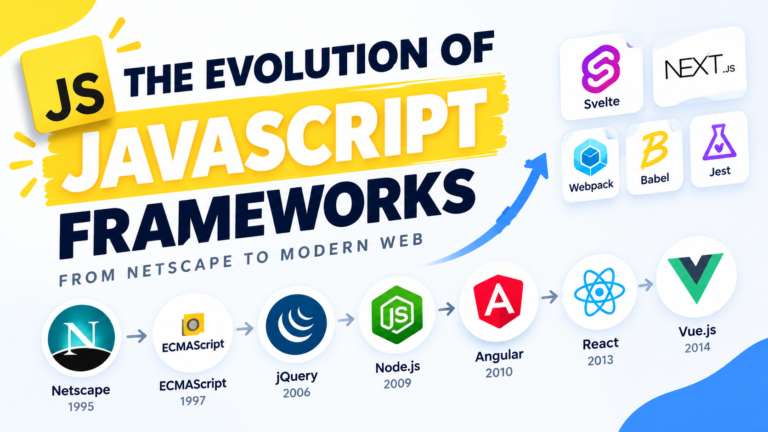
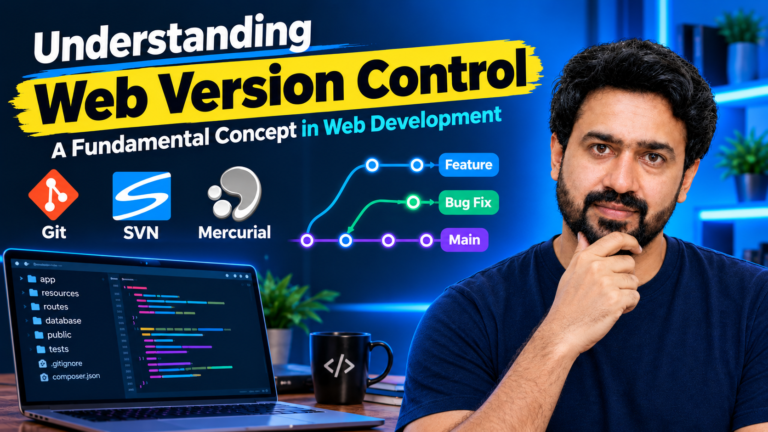
Keep going: the two skills in this article that every developer needs are version control and understanding how JavaScript frameworks evolved. Read those next.
Final Thoughts
The myth is not that full-stack developers exist. They do, and they build remarkable things. The myth is that they know everything. They do not. They know one path through the stack really well, enough of the rest to connect it, and exactly where their own limits are.
So stop measuring yourself against job ads written by people who have never built software. Build the contact form above, end to end, with your own hands. That single project teaches you more than any checklist. Then tell me in the comments which layer felt hardest. I read every comment.
If this cleared something up for you, share it with a developer who feels behind. They probably are not.