Table of Contents
In 1995, a programmer at Netscape was given ten days to invent a scripting language for the web. What he produced in that rush now runs on billions of devices and holds up half the internet.
But this article is not a list of dates. It is the story of one problem that refused to go away, and the tools built in each decade to solve it. You will see the same tiny feature written in four different eras, and by the end you will understand why React, Vue and Svelte exist at all.
What you will get (10 minute read):
✓ The one problem every JavaScript framework was built to fix
✓ A visual timeline from 1995 to today
✓ The same feature written four ways, so you can see what actually changed
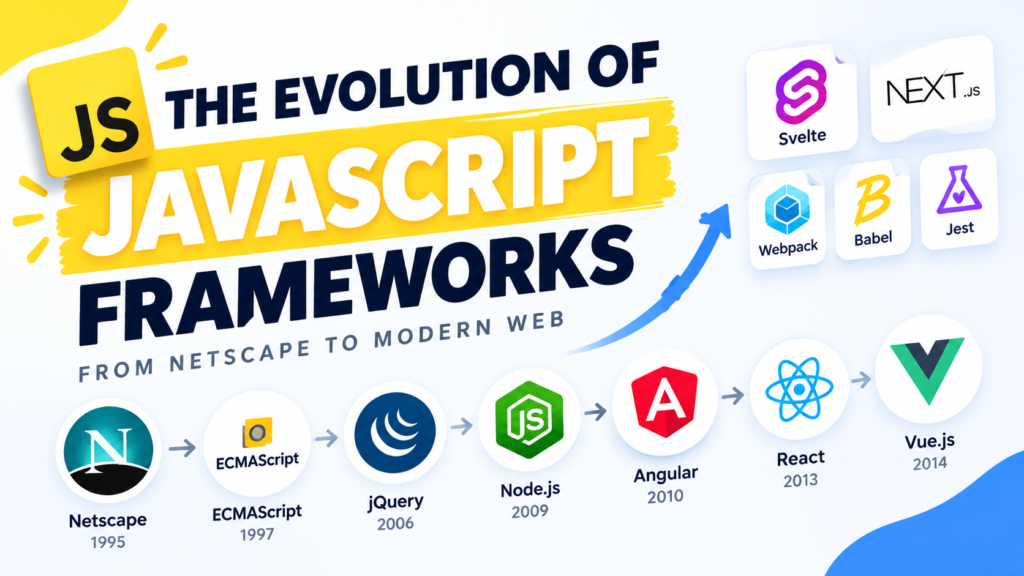
✓ A family tree of the frameworks and where each came from
✓ A straight answer to “which one should I learn in 2026?”
The Problem That Created Every Framework
Here is the whole story in one sentence: keeping what the user sees in sync with the data behind it is much harder than it looks.
Say you have a list of names. A user adds one. Now you must update the list on screen, update the counter, hide the “no items yet” message, and clear the input. Four manual updates for one action. Add a delete button, a filter and a sort, and the number of things you must remember to update grows until something gets missed. That bug, repeated across the industry for twenty years, is what frameworks were invented to kill.
Every framework in this article is an answer to the top half of this picture.
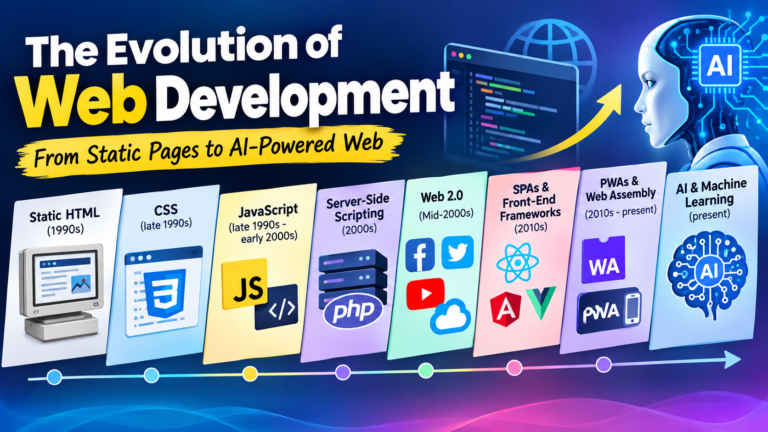
A Timeline, 1995 to Now
Brendan Eich builds it in about ten days. It ships in Netscape Navigator 2.0 under the name LiveScript, then is renamed JavaScript to ride on Java’s popularity. It has nothing to do with Java.
Netscape hands the language to Ecma International. The official standard is called ECMAScript, which is why you still see names like ES5 and ES6 today.
Netscape and Internet Explorer each add their own features. The same code behaves differently in each browser, and developers write separate versions for each one. This pain is what makes the next step inevitable.
Pages learn to fetch data from the server without reloading. Gmail and Google Maps feel like real applications. Suddenly JavaScript is not decoration any more, and the amount of it in a project explodes.
John Resig releases jQuery. One tidy syntax works in every browser, and the browser differences mostly disappear. For years, “learning JavaScript” effectively means learning jQuery.
Ryan Dahl releases Node.js. For the first time you can use one language on both sides of your app, and the npm package ecosystem begins to grow.
Google’s AngularJS introduces two-way data binding: change the data and the page changes with it. Writing full applications in the browser finally becomes practical.
Facebook releases React. Two ideas stick permanently: build interfaces out of reusable components, and describe what the screen should look like for the current data instead of patching it step by step. Everything after this borrows from it.
Evan You releases Vue, taking React’s component model and Angular’s friendliness and removing most of the setup. You can add it to one page or build an entire app with it.
let, const, arrow functions, classes, template strings, modules and promises arrive in one release. Much of what jQuery was needed for is now built into JavaScript.
Rich Harris’s Svelte does the framework’s work while your code is being built, not while the user is browsing, so less framework code is shipped to the browser. Angular is also rewritten and becomes simply “Angular”.
Next.js (for React) and Nuxt (for Vue) add routing, server rendering and build setup out of the box. React hooks arrive in 2019 and make components far shorter.
Other languages can now run in the browser at near-native speed for heavy work like video editing and games. It sits beside JavaScript rather than replacing it.
The frantic churn slows down. React, Vue, Angular and Svelte all survive, all borrow each other’s best ideas, and the arguments move from “which framework” to how much should run on the server versus the browser.
One Feature, Four Eras
Here is the feature. Type a name, press Add, and it appears in the list with a working counter and a delete button. Try it, it is live:
A real working demo, running in this page right now.
That tiny feature is the whole history lesson. Below is the code that builds it in each era. Click an era and watch what gets shorter, and more importantly, watch what disappears.
Did you spot the real change? In the first two eras, most of the code is instructions for touching the screen: create an element, set its text, append it, update the counter. In the last two, that code is simply gone. You change the array, and the screen follows. That single shift is the entire evolution.
The Family Tree
Frameworks did not appear at random. Each one was a reaction to the one before it.
What Each One Is Actually For
| Tool | Born | Use it when |
|---|---|---|
| React | 2013, Meta | You want the most jobs, the most tutorials and the biggest ecosystem. The safe default. |
| Vue | 2014, Evan You | You want the gentlest learning curve, or you need to add interactivity to an existing site a piece at a time. |
| Angular | 2016 rewrite, Google | You are on a large team that wants everything decided for you: structure, routing, forms, testing, TypeScript. |
| Svelte | 2016, Rich Harris | You want the least code and a very small bundle, and you do not mind a smaller job market. |
| Next.js / Nuxt | 2016+ | You need SEO, server rendering and routing without assembling it yourself. Built on React and Vue. |
| Node.js | 2009 | Not a front-end framework at all. It runs JavaScript on the server, behind all of the above. |
A word about “the best framework”. There isn’t one. React leads on jobs and community, Vue on approachability, Angular on structure for big teams, and Svelte on the amount of code you write. The ideas transfer between them, so your first framework is a starting point, not a life sentence.
Seeing It on Your Own Machine
You do not need to take any of this on faith. Three commands and you have a modern app running:
# Vite sets up React, Vue or Svelte for you
npm create vite@latest my-app
cd my-app
npm install
npm run dev
VITE ready in 412 ms

  ➜  Local:   http://localhost:5173/
  ➜  Network: use --host to expose
  ➜  press h + enter to show help
Example output. Open that address in your browser and edit a file; the page updates as you type.
Want to watch the old world and the new world side by side? Open DevTools with F12 and look at the Elements tab while you add an item. In plain JavaScript you can watch your own code insert the element. With a framework, you change the data and the same insertion appears without you writing it.
> names.push('Ali')
4
// list on screen:
still shows 3 items
// you forgot to redraw
> setNames([...names,'Ali'])
// list on screen:
shows 4 items
// counter updated too
Which One Should You Learn in 2026?
Here is the honest answer, in order.
For WordPress and client work: you often do not need a framework at all. Plain JavaScript handles most website interactivity, and it loads faster. Reach for a framework when your page has real application behaviour: dashboards, live filtering, multi-step forms, anything with a lot of changing state.
Mistakes That Slow Beginners Down
| Mistake | Do this instead |
|---|---|
| Jumping to React before knowing JavaScript | Learn arrays, functions and the DOM first. React will then feel obvious instead of magical. |
| Switching frameworks every few weeks | Commit to one for at least two finished projects. |
| Thinking jQuery makes you outdated | Plenty of working sites still run it. Just do not start new projects with it. |
| Installing a framework for a simple page | If a few lines of plain JavaScript do the job, use them. Your visitors get a faster page. |
| Chasing every new framework on social media | Wait a year. Most disappear; the good ideas get absorbed by the big four anyway. |
Still using var and copy-pasted ES5 | Use const and let, arrow functions and async/await. They have been standard for a decade. |
Common Questions
Is jQuery dead?
No, but it is no longer the default. A very large number of existing sites, including many WordPress themes and plugins, still use it. The reason it faded is that modern JavaScript absorbed most of its job: querySelector, fetch and classList are built into every browser now.
What is the difference between a library and a framework?
You call a library; a framework calls you. React describes itself as a library because you choose how to use it. Angular is a framework because it dictates the structure of your whole app. In everyday conversation people use the words interchangeably.
Do I need to learn TypeScript?
Not on day one, but learn it eventually. Most professional codebases and job ads now expect it. It is JavaScript with type checking added, so once JavaScript is comfortable it takes days, not months.
What is the virtual DOM and does it still matter?
It is a lightweight copy of the page that React keeps in memory. When your data changes, React compares the new copy with the old one and updates only what differs. It matters less than it once did: Svelte skips it entirely, and other frameworks now track changes more precisely instead.
Will JavaScript be replaced by WebAssembly or AI tools?
Neither looks likely. WebAssembly is built to work alongside JavaScript for heavy computation, not to replace it for building interfaces. AI tools write code faster, which makes understanding and judging that code more valuable, not less.
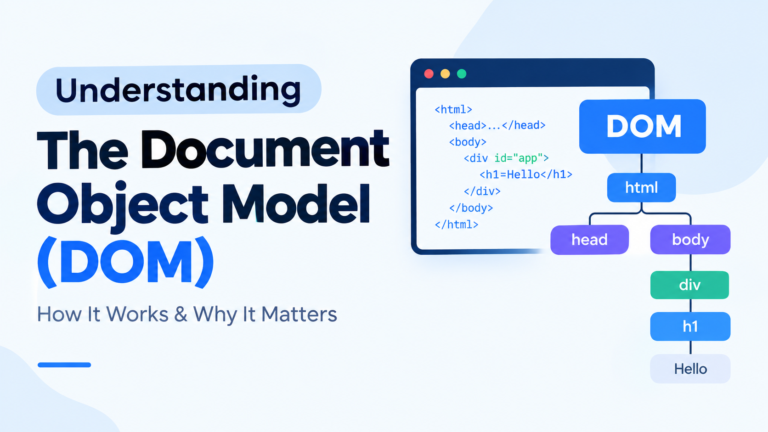
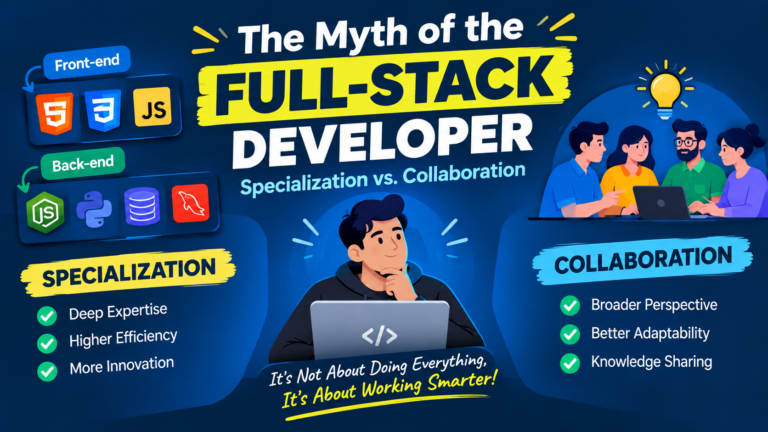
Read next: Understanding the Document Object Model (DOM) explains the thing every framework on this page is quietly managing for you. Then The Myth of the Full-Stack Developer.
Final Thoughts
Thirty years of JavaScript frameworks come down to one idea getting steadily better: stop telling the browser how to update the screen, and start describing what the screen should show. jQuery made the browser consistent. Angular introduced binding. React introduced components. Svelte moved the work to build time. Each one solved the previous one’s biggest annoyance.
So do not panic about picking the “right” one. Learn JavaScript properly, choose a framework, and build something. Which era’s code above surprised you most? Tell me in the comments. I read every one.
Found this useful? Share it with someone who is stuck choosing their first framework.